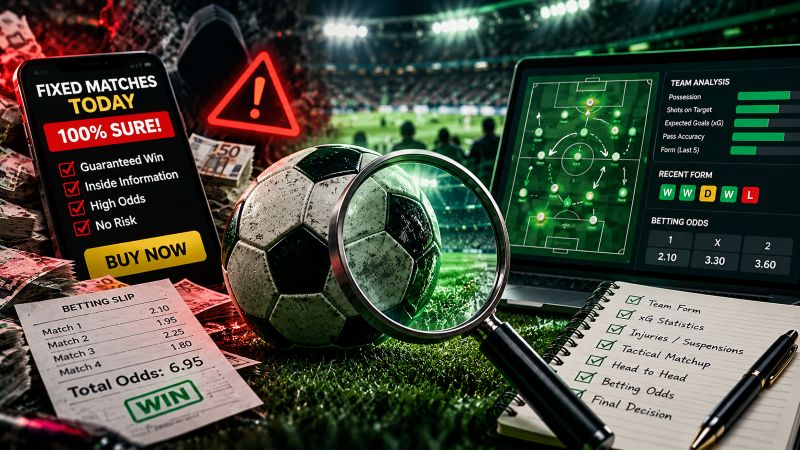
People searching for fixed matches today often encounter websites promising guaranteed football results, exclusive information or predictions described as “100% sure.”
The language can sound convincing. Some offers include screenshots of winning betting slips, impressive combined odds and claims that the information comes from people close to a team or competition.
But there is an important question behind every such offer: what evidence actually supports the claim?
Match manipulation is a genuine concern in professional football. That does not mean a website advertising a fixed match has access to a predetermined result.
Understanding the difference can help football fans recognise misleading claims, protect their money and evaluate prediction services more carefully.
This guide explains what people mean by fixed matches, why guaranteed betting claims require scrutiny and how to check the information presented by online football tipsters.
What Are Fixed Matches in Football?
In the strict sporting sense, a fixed match involves deliberate interference with a football match or competition.
That interference could concern the final result or another aspect of the game.
According to FIFA's explanation of match manipulation, improper influence can occur for financial gain or sporting advantage.
For example, manipulation might be intended to influence a betting-related outcome or provide an unfair competitive benefit.
This is fundamentally different from an analyst predicting that a team is likely to win.
An analyst makes an estimate based on the information available before kickoff. Even a well-researched prediction can be wrong.
A manipulated match, by contrast, involves an attempt to improperly influence what happens on the pitch.
The distinction matters because the expression fixed matches is used in different ways online.
Some websites discuss genuine match-fixing investigations. Others use the term to market ordinary football predictions as unusually reliable or exclusive.
For a more detailed introduction, read our guide to fixed matches and the facts behind them.
Are Fixed Matches Today Really Available Online?
You may encounter websites advertising fixed matches today, upcoming fixed games or supposedly confirmed football results.
However, the existence of an advertisement is not evidence that the seller possesses genuine information about a manipulated match.
A website can publish a fixture, name a predicted outcome and describe it as fixed without demonstrating that any manipulation has occurred.
There is also an important difference between a claim being specific and a claim being verifiable.
Consider these statements:
- "Our analysts expect the home team to win based on its recent performances."
- "We have a highly confident prediction for tonight's match."
- "The final result is already arranged and cannot lose."
The first is an analytical opinion that readers can examine.
The second expresses confidence but requires supporting evidence.
The third makes an extraordinary allegation about the integrity of a sporting event.
Such an allegation should not be accepted merely because someone asks for payment or displays a betting screenshot.
A prediction is not proof of match manipulation, and a successful prediction does not establish that a match was fixed.
Why Do Websites Advertise 100% Sure Fixed Matches?
The phrase 100% sure fixed matches is designed to remove uncertainty from a decision that normally involves risk.
A person considering a football bet might be attracted to the idea that the outcome has already been decided.
But confidence and certainty are not interchangeable.
A selection can be supported by statistical analysis, tactical information and confirmed team news while still being incorrect.
A claim of guaranteed success requires evidence far beyond an ordinary prediction record.
When examining a website that advertises certainty, ask:
1. Is the claimed information independently verifiable?
2. Does the seller explain the source of its certainty?
3. Are losing selections also visible?
4. Can previous predictions be verified as published before kickoff?
5. Is the website confusing a strong prediction with a supposedly predetermined outcome?
These questions help separate analytical information from unsupported marketing.
No amount of confident wording can eliminate the uncertainty inherent in ordinary football predictions.
Genuine Fixed Matches vs Genuine Football Predictions
The phrase genuine fixed matches often appears in online searches, but the word “genuine” does not authenticate a seller's claims.
It is useful to distinguish between three categories.
1. Documented match manipulation
This involves a match or incident examined through relevant sporting, regulatory or legal processes.
Official investigations may involve evidence from multiple sources, including participants, investigators and betting-integrity monitoring.
Readers interested in the wider integrity issue can consult UEFA's anti-match-fixing information.
2. Evidence-based football predictions
These are assessments based on factors such as team form, injuries, tactical match-ups and betting odds.
An analyst might believe a particular outcome is more likely, but that belief does not make the outcome predetermined.
A transparent prediction should contain enough information for readers to understand the reasoning and evaluate the historical record.
3. Unsupported claims of guaranteed results
These are offers where the seller says an outcome is fixed, certain or available through exclusive inside information without providing independently credible evidence.
The claim may be accompanied by winning screenshots, testimonials or urgent sales messages.
None of those elements, individually, establishes that a match has been manipulated.
Recognising these different categories is essential when evaluating information about football matches.
Seven Warning Signs to Check Before Trusting a Fixed Match Offer
Some warning signs deserve particular attention when researching online football information.
1. Guaranteed success claims
Statements such as "100% sure," "never loses" and "guaranteed correct score" should invite scrutiny.
A genuine prediction service should explain uncertainty rather than suggest that losses are impossible.
2. No complete results archive
A page displaying only successful selections provides an incomplete picture.
Ask whether previous unsuccessful predictions remain available.
Also consider whether the website distinguishes between predictions originally published before kickoff and results added afterward.
3. Screenshots without verifiable context
A winning betting-slip image can show what appears to be a successful wager.
It does not automatically prove when a prediction was shared publicly, whether the record is complete or whether other selections were unsuccessful.
Images may also be altered, mislabelled or presented without the context needed to assess them.
A screenshot should be treated as supporting material, not conclusive evidence.
4. Pressure to make an immediate payment
Be cautious when a seller insists that payment must be completed immediately and refuses to provide basic information about what is being purchased.
Time-sensitive promotions are common in many industries, but pressure should not replace transparency.
5. Unclear terms and identity
Before paying for any online service, readers should understand the price, what is included, how delivery works and which terms apply.
Missing or contradictory information increases uncertainty about the transaction.
6. Repeated requests for additional payments
A seller who requests an initial payment and then repeatedly demands more money before providing the promised service deserves additional scrutiny.
This is especially concerning when the original terms did not explain those charges.
7. Claims that cannot be independently checked
Statements about secret sources, confidential arrangements or guaranteed outcomes are difficult to evaluate without reliable independent evidence.
A claim should not become more convincing simply because its alleged source cannot be questioned.
A Practical Method for Checking Football Prediction Claims
You do not need access to a sophisticated betting database to begin evaluating the transparency of a prediction website.
A consistent verification process can reveal important gaps.
Check 1: Find the original publication time
Look for evidence that the prediction existed before the match started.
A final score displayed beside a prediction after the event is not enough.
The important question is whether the original selection was recorded or published before kickoff.
Check 2: Compare the original prediction with the final result
The market, selected outcome and recorded odds should be consistent with the original entry.
Corrections should be clearly identified rather than silently replacing past information.
Check 3: Examine both winning and losing entries
A reliable record should not depend on hiding unsuccessful predictions.
Review a sufficiently broad history instead of relying on a handful of selected examples.
Check 4: Read the explanation
Does the service provide football-related reasoning, such as tactical factors and player availability?
Or does it rely entirely on claims of certainty and access to secret information?
Reasoning is not proof of accuracy, but it provides something readers can evaluate.
Check 5: Inspect the terms
Understand whether the service offers informational predictions, analysis or something else.
Any claim about guaranteed outcomes should be treated separately from ordinary analytical services.
Check 6: Compare the claims with credible sources
If a website alleges that a particular match has been manipulated, look for reliable independent reporting or information from an appropriate integrity authority.
Do not interpret speculation or an unusual betting price as proof of wrongdoing.
Two Examples: Why Evidence Matters More Than Screenshots
Consider two fictional online services. These examples are hypothetical and do not describe specific companies.
Example A: A winning screenshot with no publication history
A website displays a betting slip showing a successful four-match combination.
The image includes the matches, odds and a potential return.
However, there is no accessible record showing when the selections were originally shared.
The site also does not provide a complete record of unsuccessful selections.
What can a reader conclude?
The screenshot alone cannot establish a reliable historical prediction record, and it certainly does not prove the matches were fixed.
Example B: A dated prediction with an accessible history
Another website publishes a selection before kickoff and preserves the original record.
After the match, it adds the final score and result status without changing the original prediction.
Previous winning and losing selections remain available.
What can a reader conclude?
This provides more useful evidence about the service's record-keeping and prediction history.
However, even a perfectly transparent prediction archive does not prove that future outcomes are certain.
Transparency and guaranteed accuracy are different things.
Can Betting Odds Reveal a Fixed Match?
Betting odds reflect market prices for possible outcomes.
Changes in odds can occur for various reasons, including new team information, changes in market expectations and betting activity.
An unexpected change may attract attention, but it should not automatically be interpreted as evidence that a match is fixed.
Specialist integrity organisations assess suspicious circumstances using information that goes beyond a single publicly visible price movement.
UEFA explains that protecting football integrity involves education, detection, investigation and cooperation with relevant authorities.
You can learn more from UEFA's official anti-match-fixing programme.
For ordinary readers, the practical rule is straightforward:
Unusual odds are not, by themselves, proof of match manipulation.
Why Football Match-Fixing Is an Integrity Issue
Match manipulation damages the fairness of competition.
It can undermine confidence among supporters, players, clubs and everyone who depends on sporting results being decided through legitimate competition.
Football authorities have established mechanisms intended to identify and address suspected manipulation.
FIFA explains that match manipulation can involve attempts to improperly influence either the result or other aspects of a competition.
The organisation also provides official mechanisms for reporting potential match manipulation.
If someone has credible information about possible manipulation, the appropriate response is to use relevant official reporting channels, rather than circulating unsupported accusations or attempting to profit from the information.
Suspicions should be treated responsibly, particularly when they could affect the reputations of identifiable people or teams.
What Should You Look for Instead of Guaranteed Fixed Matches?
Readers interested in football predictions are better served by information they can examine.
A useful match assessment may consider:
- Recent performances and the quality of previous opponents.
- Expected goals and the quality of scoring chances.
- Injuries, suspensions and confirmed line-ups.
- Home and away performance.
- Tactical strengths and weaknesses.
- Fixture congestion and recovery time.
- Market prices and the uncertainty around them.
None of these factors guarantees a result.
Together, however, they provide a more informative foundation than an unsupported promise of certainty.
For a practical explanation of this process, visit the LegitPredictions match analysis approach.
Readers can also explore our free football predictions to see the published selections available on the site.
How LegitPredictions Approaches Football Predictions
LegitPredictions distinguishes football match analysis from claims of guaranteed or pre-arranged results.
The website's stated approach is based on evaluating factors such as recent team performance, player availability, tactical match-ups and available odds.
Readers can consult the public results archive when assessing historical selections.
The important distinction is that a football prediction expresses an opinion about what may happen. It does not establish that anyone has arranged the result in advance.
LegitPredictions does not claim to sell or possess fixed matches. This is also explained on the site's fixed matches information page and in its responsible betting disclaimer.
When considering any prediction service, readers should judge the evidence, the transparency of the results and the clarity of the information provided.
Frequently Asked Questions About Fixed Matches
Are there real fixed matches in football?
Match manipulation is a genuine integrity issue recognised by football authorities. However, this does not establish that websites advertising secret or guaranteed results possess authentic information.
Can I find 100% sure fixed matches today?
A website claiming to offer 100% sure fixed matches should not be considered trustworthy merely because of that claim. Independently credible evidence is necessary, and a successful prediction does not prove a game was manipulated.
Are genuine fixed matches sold online?
Online advertisements may claim to sell genuine fixed matches, but the advertisement itself does not verify the information. Be cautious about offers involving guaranteed outcomes or alleged secret arrangements.
Are fixed matches the same as football predictions?
No. In the sporting sense, a fixed match involves deliberate manipulation. A football prediction is an estimate of an uncertain outcome based on available information.
Do winning bet slips prove a match was fixed?
No. A winning slip does not demonstrate deliberate manipulation of a sporting event. It also does not, by itself, verify an entire prediction history.
How can I recognise misleading fixed match websites?
Look for unsupported guarantees, missing historical records, unclear terms, pressure to pay and screenshots presented without verifiable context.
Can a football match be predicted with 100% accuracy?
No ordinary football prediction method can guarantee an exact future outcome. Even careful analysis remains subject to uncertainty.
Where can suspected match manipulation be reported?
FIFA provides official integrity reporting mechanisms. Depending on the circumstances, relevant national football authorities or law-enforcement bodies may also have reporting channels.
Final Thoughts: Treat Fixed Match Claims With Care
The popularity of searches for fixed matches today reflects a desire for reliable football information.
But a guarantee is not evidence, and confidence should never replace verification.
Real match manipulation is a serious issue, while ordinary football predictions remain uncertain assessments of future events.
Before trusting a claim about a supposedly guaranteed match, examine the publication history, the supporting evidence, the completeness of the results and the credibility of the sources.
The most useful football information is not necessarily the information delivered with the greatest certainty. It is information that can be questioned, checked and understood.
For more information, read Fixed Matches: The Facts or explore the LegitPredictions Blog.
---
Official Sources and Further Reading
- FIFA — Match Manipulation
- FIFA — Integrity Reporting Mechanisms
- UEFA — Anti-Match-Fixing
- LegitPredictions — Fixed Matches: The Facts
Responsible Gambling: This article is educational and does not provide guaranteed football results or access to manipulated matches. Betting carries financial risk. Only participate if you meet the applicable legal age requirements and betting is permitted in your jurisdiction. Never stake money you cannot afford to lose. Read the LegitPredictions Disclaimer for more information.
- #fixed matches
- #match fixing
- #football predictions
- #betting scams
- #football integrity